
A generative algorithm that translates live financial market data into a self-evolving architectural installation built autonomously by drones, reshaped continuously by human interaction.
Context: AA Thesis, Intermediate 5 / 2022–23
Recognition: ML System Design · Spatial Translation · Gamification · Human-Computer Interaction
Stack: Rhino8, Unreal Engine, Figma AI, Adobe Illustrator, Adobe InDesign
This page covers the REWIRE Algorithm. The link to the architectural thesis book can be found here.
The Question
Banks commission art as cultural goodwill. What if that commissioned art used the bank’s own data to critique it and rebuilt itself every time someone interacted with it?
REWIRE is an architectural protest. The sculpture is commissioned by the bank, sited on the bank’s facade, powered by the bank’s financial data. Participants can physically remove copper segments from the installation, feeding that act back into the algorithm as new input. The more volatile the market, the more complex the weave. The more people interact, the more the structure transforms. The bank pays for its own undoing.
Who is this for?
Three stakeholders, three different relationships to the same structure:
The bank commissions the intervention as a symbol of cultural investment. It funds a protest against itself without knowing it.
Day traders who lost money to the bank’s speculation can physically acquire copper segments; each becomes a tokenised NFT, recouping value from the institution that extracted it.
Pedestrians whose circulation patterns on the site become live data input into Phase 3 of the algorithm. Their presence shapes the structure’s complexity.
The System
The REWIRE algorithm runs in four phases, each using a different data type and different material:
Algorithm Overview:

Phase 0 is site analysis. The UAV is programmed to analyze the site and identify architectural latches on the site.
Phase 1 is site-specific, using aluminum pipes to latch onto existing architectural elements.
Phase 2 is data-specific, using numeric data. It uses elastic wires to create nodes to trace JP Morgan’s growth over the past 3 decades.
Phase 3 is context-specific, which dynamically weaves data nests using copper wire, based on pedestrian circulation on the site.
Simultaneous to the iterative construction, there are 3 attachments with separate functions that aid the protest: Data Nests Attachment, Coordinate Nodes Attachment, Seating Shards. (More details on these elements can be found on pages 30-31 of the thesis). The UAV also reads wireless network frequencies on the trading floors as it weaves its path and uses that as dynamic additional input data to create a more complicated street-level architectural installation.
Therefore, the higher and the more volatile the frequency, the more aesthetic the intervention, thus attracting more human traction. The added traction is grasped by the algorithm and used to alter the physical intervention.
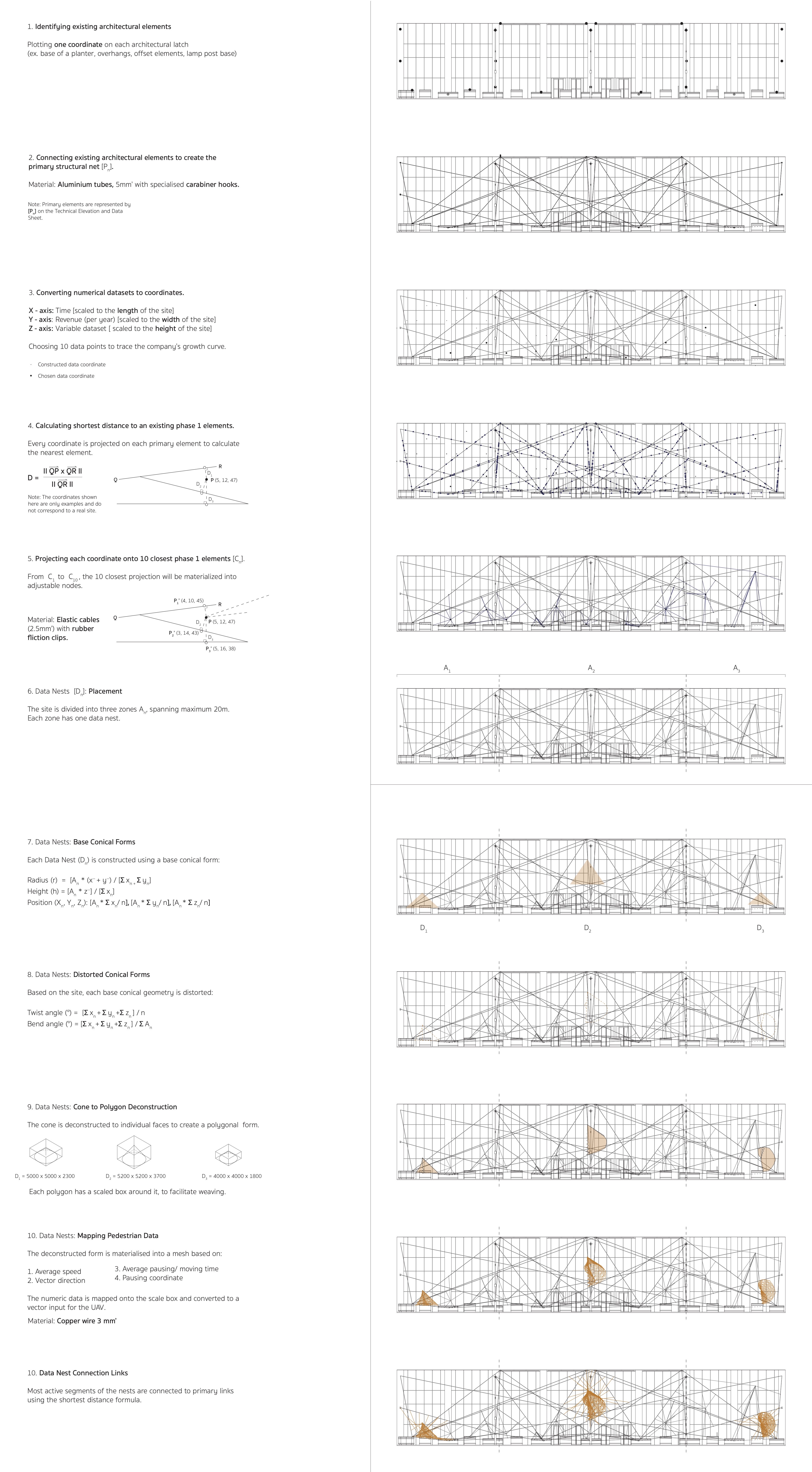
Note: Please zoom in to see all elements.

Note: Labelled elements must be read in conjunction with the REWIRE Algorithm Diagram.
Phase 0: Site Analysis
- The UAV scans the JP Morgan 25 Bank Street site and maps it onto a 3D Cartesian coordinate grid
- Identifies architectural latches: hollow facade pipes, street overhangs, CCTV casings, wall-mounted lamps, lamp posts, traffic signals, planters
- These latches become the fixed anchor points for Phase 1 construction
- The grid converts any numerical dataset into spatial coordinates that can be materialised
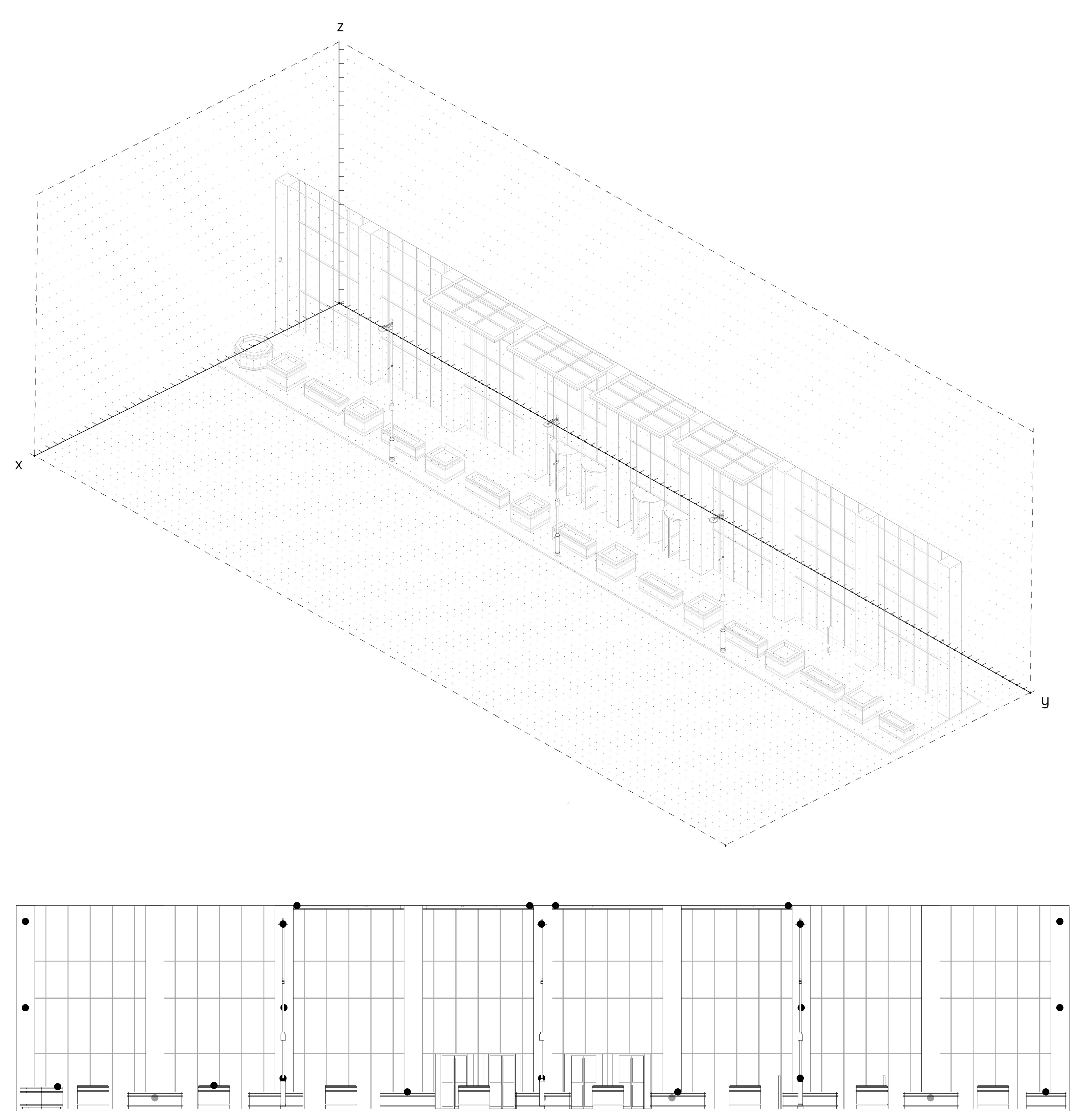
The JP Morgan site is mapped onto a scaled 3D vector space. The UAV then identifies architectural latches on the site. For JP Morgan, specific latches include:
| 25 Bank Street: Specific Architectural Latches | CANARY WHARF: COMMON STREET-FURNITURE |
|---|---|
| Hollow Facade Pipes | Lamp Posts |
| Street Overhangs | Traffic Signals |
| CCTV Casings | Planters |
| Wall-mounted Lamps | Traffic Cones |
Phases 1, 2, 3

Phase 1: Site-specific construction
- Aluminium pipes are latched onto identified architectural elements
- This phase follows the site geometry
- Creates the structural skeleton that Phases 2 and 3 will weave through
Phase 2: Data-specific construction
- JP Morgan’s 30-year stock growth data is converted to elastic wire node positions
- Each data point becomes a physical node in the structure
- Wire tension encodes market volatility: high variance periods create denser, more chaotic spans
Phase 3: Context-specific construction (the live layer)
- Copper wire is woven based on real-time pedestrian circulation
- The UAV also reads wireless network frequencies from trading floors as it weaves
- Higher market frequency = more complex weave = more visual interest = more pedestrian traction = more input data
This is the feedback loop: the sculpture becomes more complex as more people engage with it.
Architectural Drawings: Final Intervention
This section shows architectural drawings and visualizations of the resulting space once JP Morgan’s quantitative data is processed through the REWIRE algorithm and converted to a spatial intervention.

Visualizations
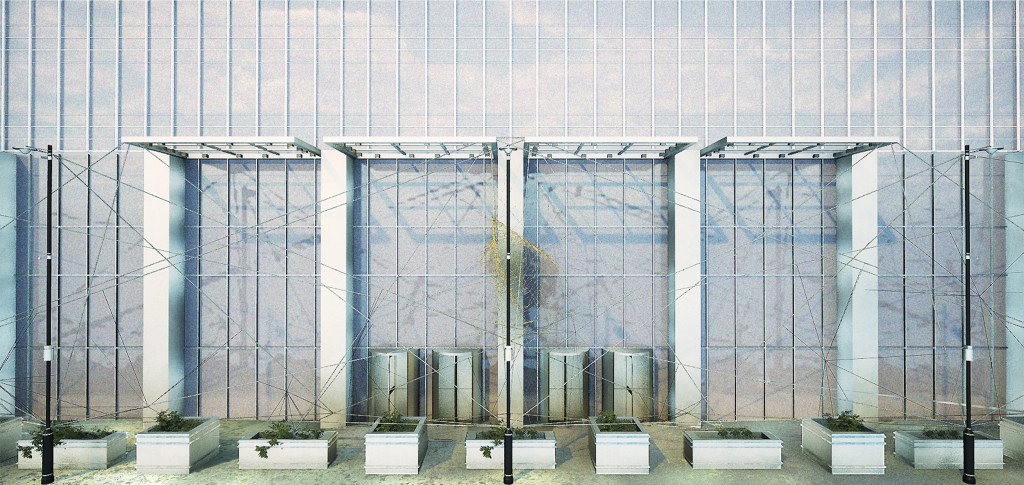
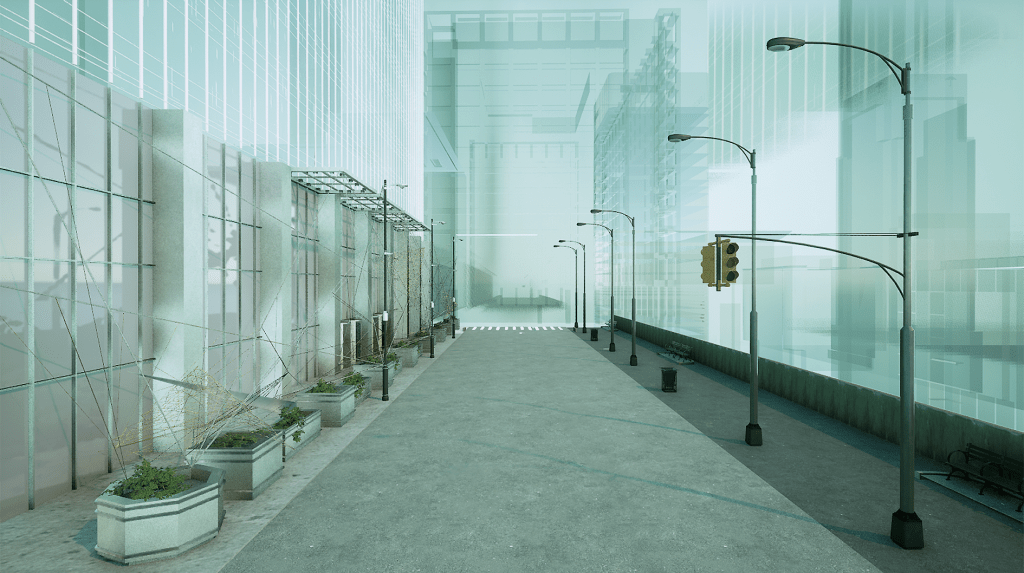
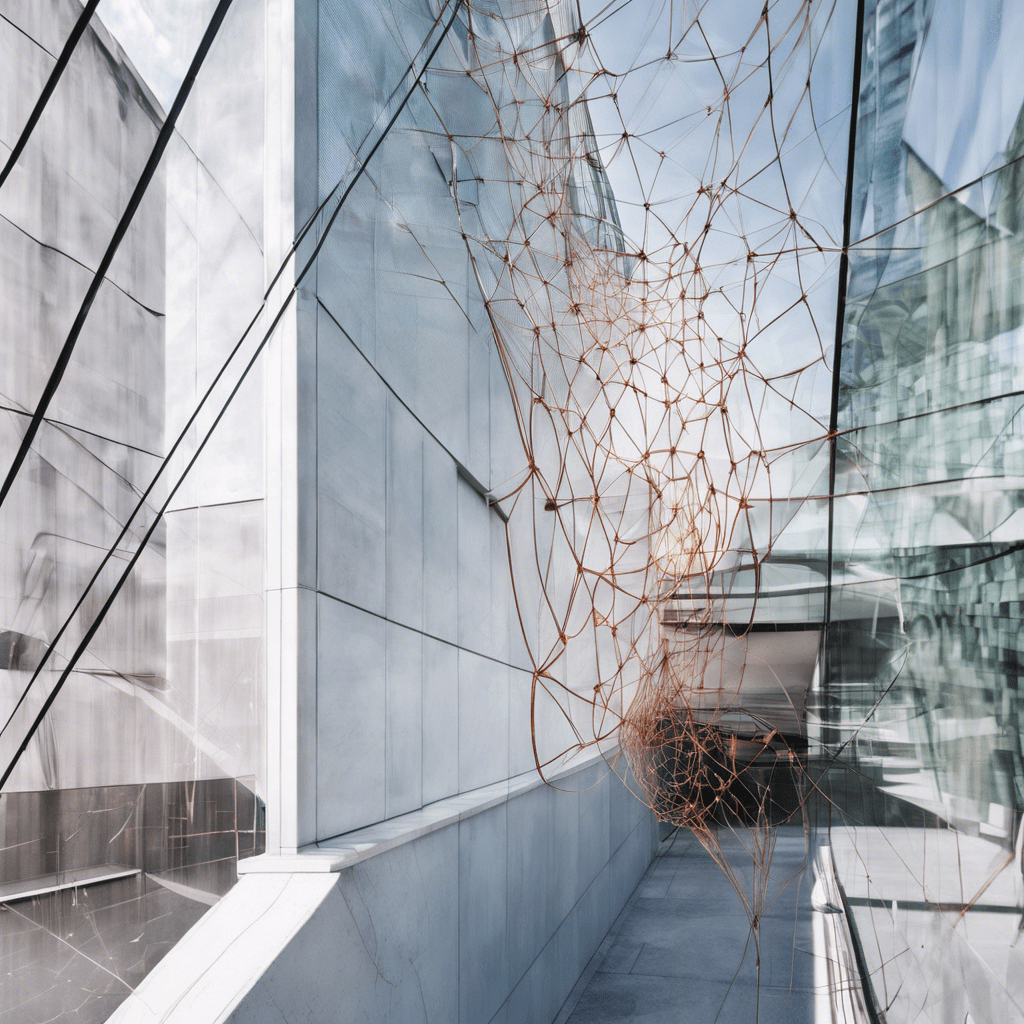
These visualizations show the architectural intervention as a streetside extension to JP Morgan’s 25 Bank Street site in Canary Wharf. The views show aluminum pipes (phase 1), elastic cables (phase 2), copper wire and data nests (phase 3), coordinate nodes, and seating shards at different times of the day.


Designing for Redundancy in the System
One of the hardest design problems: how do you let protesters physically remove parts of the sculpture without the whole thing collapsing?
“Breaking points” are structural weak links engineered deliberately into the algorithm’s output- segments that can be detached without compromising the installation’s overall integrity. Each acquired segment becomes tokenised as an NFT on the REWIRE platform, allowing day traders to recoup losses from the very institution that commissioned the protest.

The plan, front elevation, and right elevation on this unfolded drawing show a time-based interaction between pedestrians and protestors within the same architectural intervention.
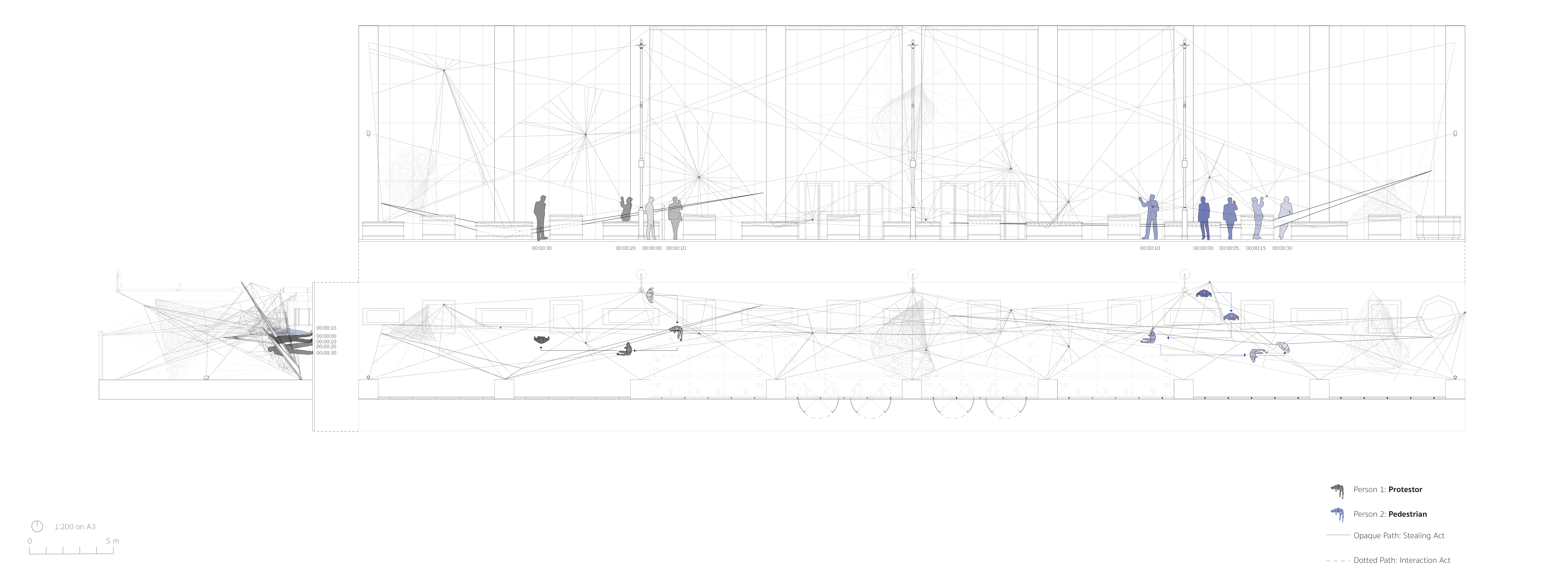
Protesters follow pre-organized circulation paths and acquire pre-identified copper segments to physically redesign the intervention.

The protest ends in an architectural collapse with the dense web of copper, once an architectural marvel, becoming a formidable blockade, rendering the building entrance impassable. The REWIRE intervention, once an artistic and data-driven masterpiece, now serves as a catalyst for a massive paradigm shift, pushing society to confront the dark underbelly of financial institutions.
Designing the Construction Mechanism
The algorithm is only half the system. The UAV has to physically execute it, which means designing the mechanical attachments that allow a drone to behave like fingers.
To attach hooks for phase 1, create nodes for phase 2, and tie knots for phase 3, the UAV needs to work like fingers. This drawing outlines the three attachments designed to help the UAV conduct relevant movements. Each attachment helps replicate a finger movement clasping, pressing, and holding).
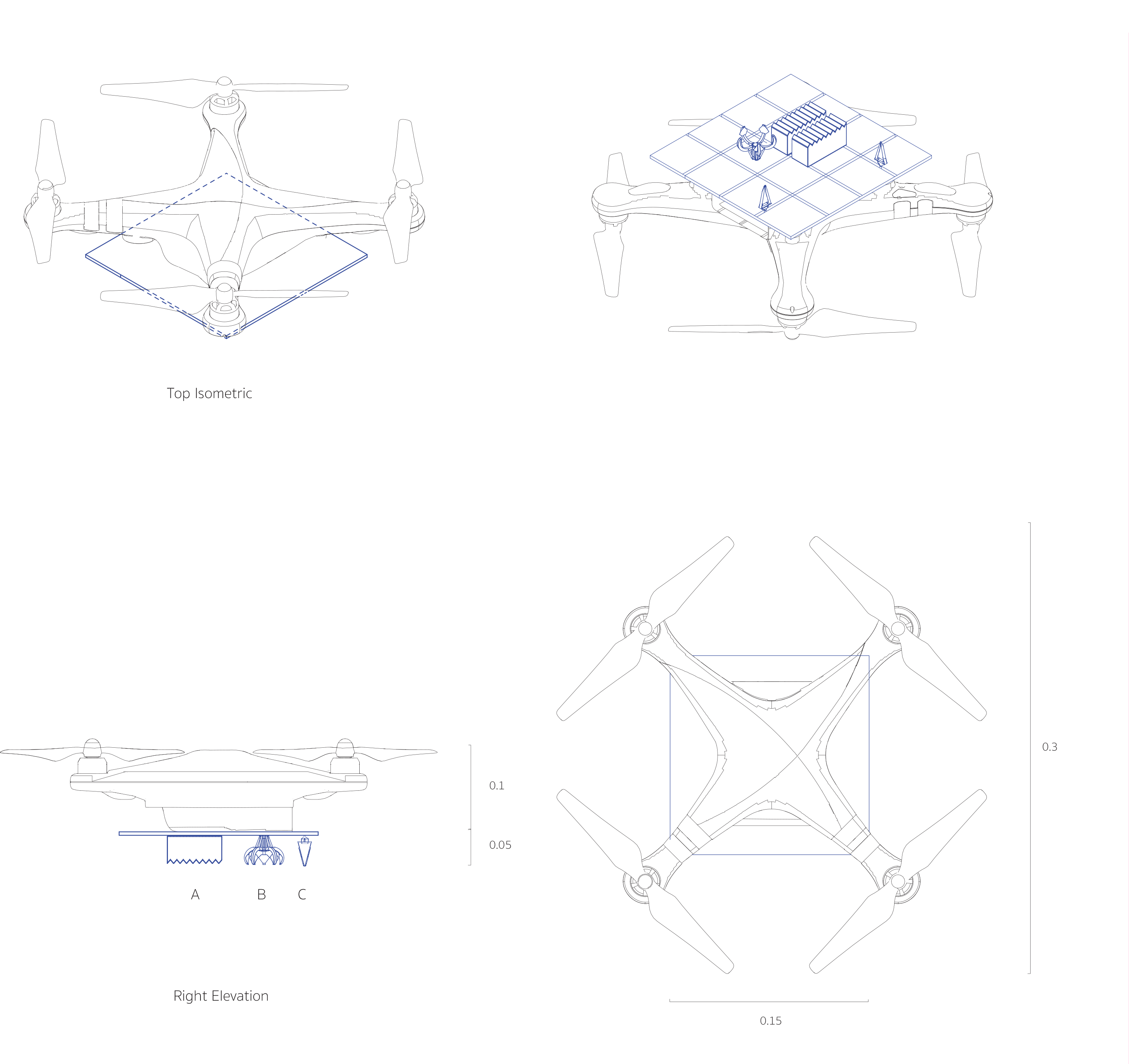
Three attachments aid UAV construction:
- Grabber: Releases and grabs the weighted Free End of the copper wire.
- Presser: Is fixed on the UAV base and is used to press parts of the knot.
- Holders: There are two holders, which hold and work the wires.

Prototyping
Physical tests came before digital simulation. Weaving behaviour with elastic string, sewing thread, and 9-gauge guitar wire across linear, surface, and volumetric structures established the material constraints that the algorithm had to respect.
Test 1: Weaving using wires
Linear structures, surface structures, and volumetric structures are connected at nodes. The node connection varies by material type and factors like friction, torsion capacity, tensile strength, and elasticity need to be considered when analyzing the result.


Test 2: Digital MATLAB UAV Movement Simulation using AI
Digital simulation in MATLAB followed, testing three distinct movement scenarios:
Moving obstacle avoidance: detecting pedestrians, predicting their direction, and adjusting trajectory to avoid injury
Waypoint following: the fundamental path-tracing logic that allows the UAV to weave Phase 1 elements onto architectural latches
Static obstacle avoidance (LiDAR): detecting parked vehicles, lamp posts, existing Phase 1 and 2 elements, and routing around them in real time
Enhancing the project using AI
REWIRE was built before the current generation of generative AI tools. With today’s stack, two things would change substantially:
- Coordinate generation: Replace drone-mapped architectural latch detection with a diffusion model conditioned on live market sentiment feeds: social commentary, trading volume spikes, news events. The sculpture’s geometry would respond to cultural mood, not just numerical data.
- Narrative output: Add an LLM layer that writes the protest in real time. The same data shaping the sculpture’s form also generates text projected onto the facade, updated continuously. The building speaks its own critique.
- Workflow acceleration: ComfyUI pipelines generating weave pattern variations as image outputs before physical construction, allowing human curation of aesthetic direction before UAV execution begins. The generative system produces options; the human decides which iteration builds.
Note: This project won the Peter Sabara Travel Award 2023, granted by the Architectural Association (AA) School of Architecture.
Additional Links:
Final REWIRE Technical Thesis: Link

