
(Note: This project was conceptualized for design unit Intermediate 5 with tutors Ryan Dillon and David Greene at the Architectural Association (AA), with technical guidance under Kenneth Fraser and Simon Beames from the TS department at AA. 2022-23).
Project Overview
REWIRE is an architectural protest uniting architecture, data, and political activism to challenge capitalistic banks and empower day traders. It aims to rewrite the rules by leveraging corporate culture against entities perpetuating inequality and greed. The REWIRE algorithm outlines logical steps that translate numeric data to an on-site architectural spatial intervention, constructed entirely by Unmanned Aerial Vehicles (UAV).
In the designed system, the spatial intervention is commissioned by banks, serving as a symbol and catalyst for protest. Participants physically acquire copper fragments, from the spatial sculpture, symbolically appropriating banks’ unethical practices towards capitalistic exploitation and excessive energy usage. Acquired copper fragments are tokenized as non-fungible tokens (NFTs) using blockchain technology. This fusion of physical and digital assets empowers day traders to leverage the digital trading market, potentially recouping losses and benefiting from acquired fragments.
The architectural focus extends beyond the intervention itself. It disrupts conventional protest notions by leveraging corporate culture against entities perpetuating inequality and greed. Situated on banks’ sites, the space challenges the status quo, as a rallying point for dissent and unity against systemic banking injustices. As a transformative movement, REWIRE harnesses architecture, data, and political activism. Participants disrupt wealth accumulation cycles and reclaim financial agency by appropriating fragments from commissioned interventions. Participant interaction with the space is quantified and used as data input to feed the REWIRE algorithm to create a more complex architectural output, enabling the system to work as a spatial machine-learning network. It invites participants to transcend traditional systems, rewrite the rules, and forge a more equitable future.
This page covers the REWIRE Algorithm. The link to the architectural thesis book can be found here.
The REWIRE Algorithm
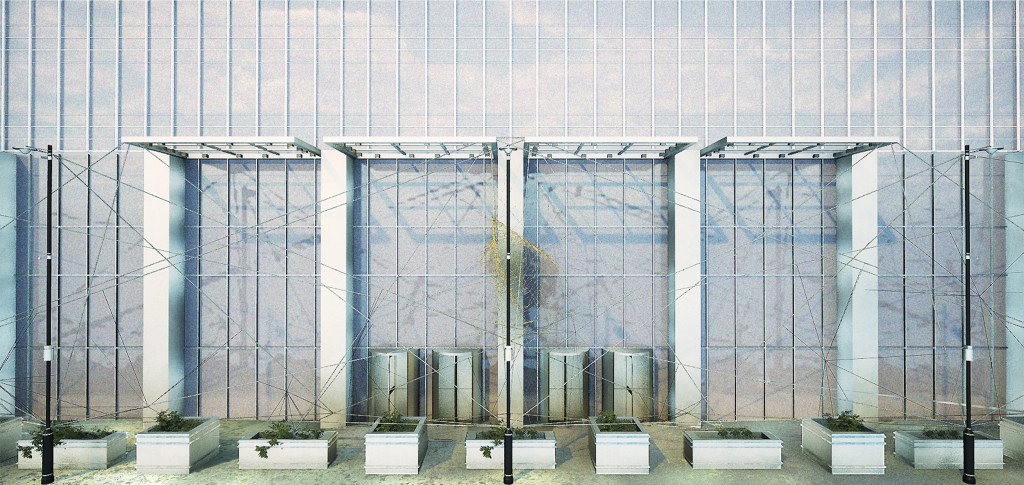
The REWIRE Algorithm is designed to dynamically create a spatial intervention using quantitative data inputs native to the bank commissioning the intervention. This example uses JP Morgan’s data for their 25 Bank Street, London, site. The numeric data gets converted to spatial coordinates and gets mapped onto JP Morgan’s street extension. The steps of the algorithm iteratively construct the intervention over a timeframe of 4 days and 23 hours of active trading period for banks. The construction is entirely autonomous, conducted by Unmanned Automated Vehicles (UAVs) that follow the algorithm using coordinate inputs.
Algorithm Overview:

Phase 0 is site analysis. The UAV is programmed to analyze the site and identify architectural latches on the site.
Phase 1 is site-specific, using aluminum pipes to latch onto existing architectural elements.
Phase 2 is data-specific, using numeric data. It uses elastic wires to create nodes to trace JP Morgan’s growth over the past 3 decades.
Phase 3 is context-specific, which dynamically weaves data nests using copper wire, based on pedestrian circulation on the site.
Simultaneous to the iterative construction, there are 3 attachments with separate functions that aid the protest: Data Nests Attachment, Coordinate Nodes Attachment, Seating Shards. (More details on these elements can be found on pages 30-31 of the thesis). The UAV also reads wireless network frequencies on the trading floors as it weaves its path and uses that as dynamic additional input data to create a more complicated street-level architectural installation. Therefore, the higher and the more volatile the frequency, the more aesthetic the intervention, thus attracting more human traction. The added traction is grasped by the algorithm and used to alter the physical intervention.
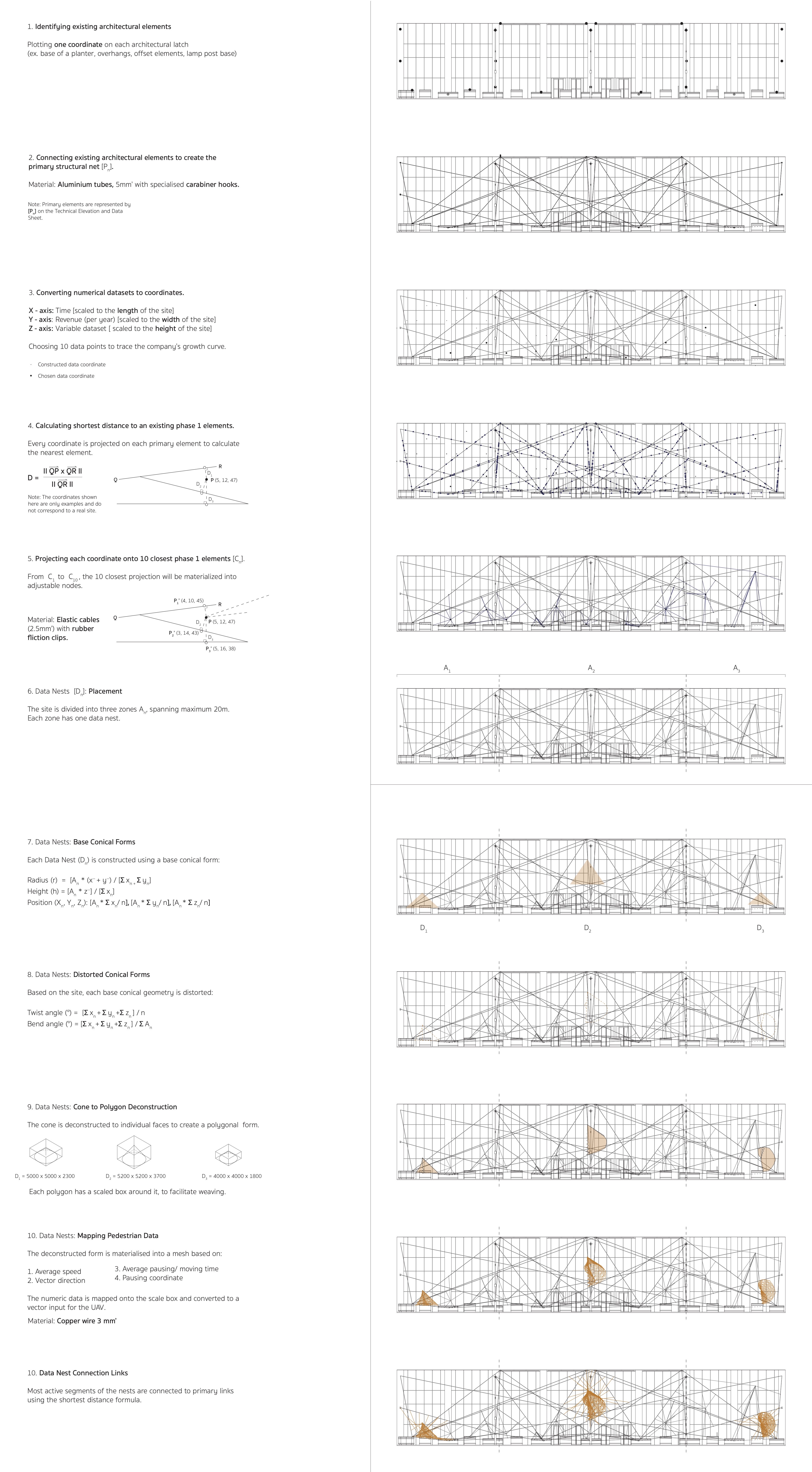
Note: Please zoom in to see all elements.

Note: Labelled elements must be read in conjunction with the REWIRE Algorithm Diagram.
Phase 0
The REWIRE algorithm converts any numerical data to a spatial intervention on a given site. The data is modulated, mapped, and translated onto the site using vector coordinates, which are materialized into a spatial artifact by UAVs. The site is first converted into a 3D cartesian coordinate grid. Next, the UAV scans the site identifies architectural latches, outlined on previous pages, and extracts coordinates.
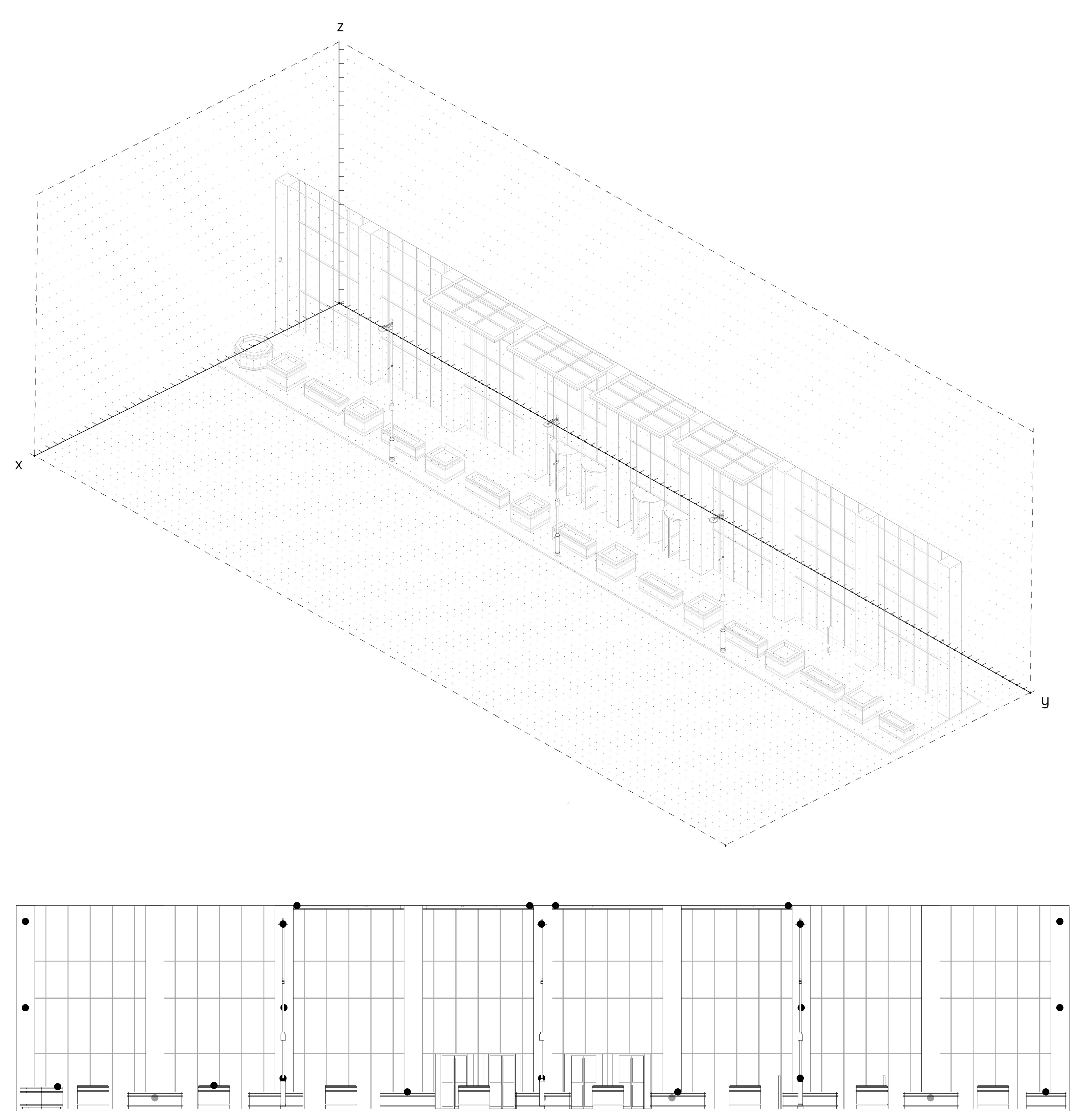
The JP Morgan site is mapped onto a scaled 3D vector space. The UAV then identifies architectural latches on the site. For JP Morgan, specific latches include:
| 25 Bank Street: Specific Architectural Latches | CANARY WHARF: COMMON STREET-FURNITURE |
|---|---|
| Hollow Facade Pipes | Lamp Posts |
| Street Overhangs | Traffic Signals |
| CCTV Casings | Planters |
| Wall-mounted Lamps | Traffic Cones |
Phases 1, 2, 3

Architectural Drawings: Final Intervention
This section shows architectural drawings and visualizations of the resulting space once JP Morgan’s quantitative data is processed through the REWIRE algorithm and converted to a spatial intervention.

Visualizations
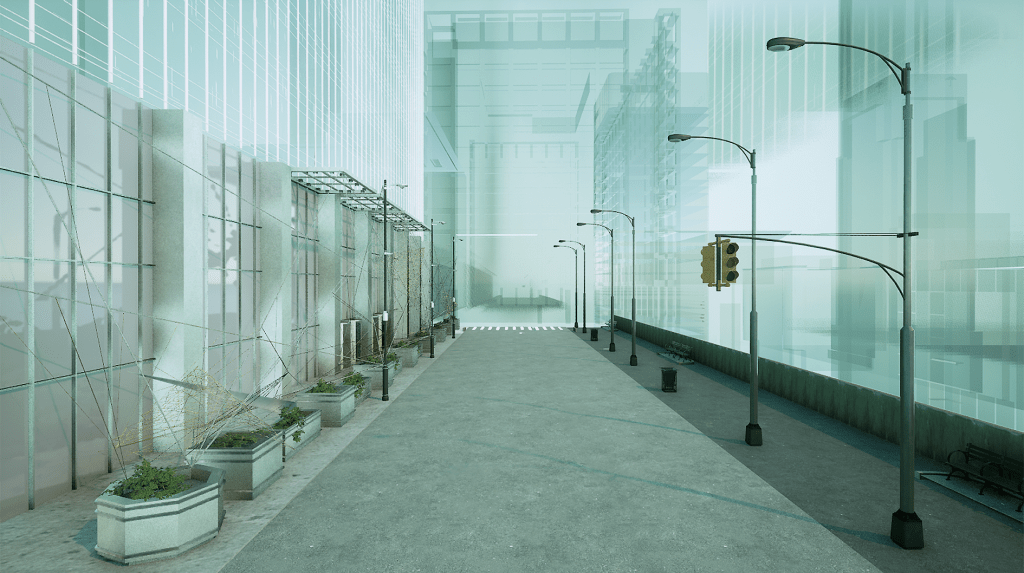
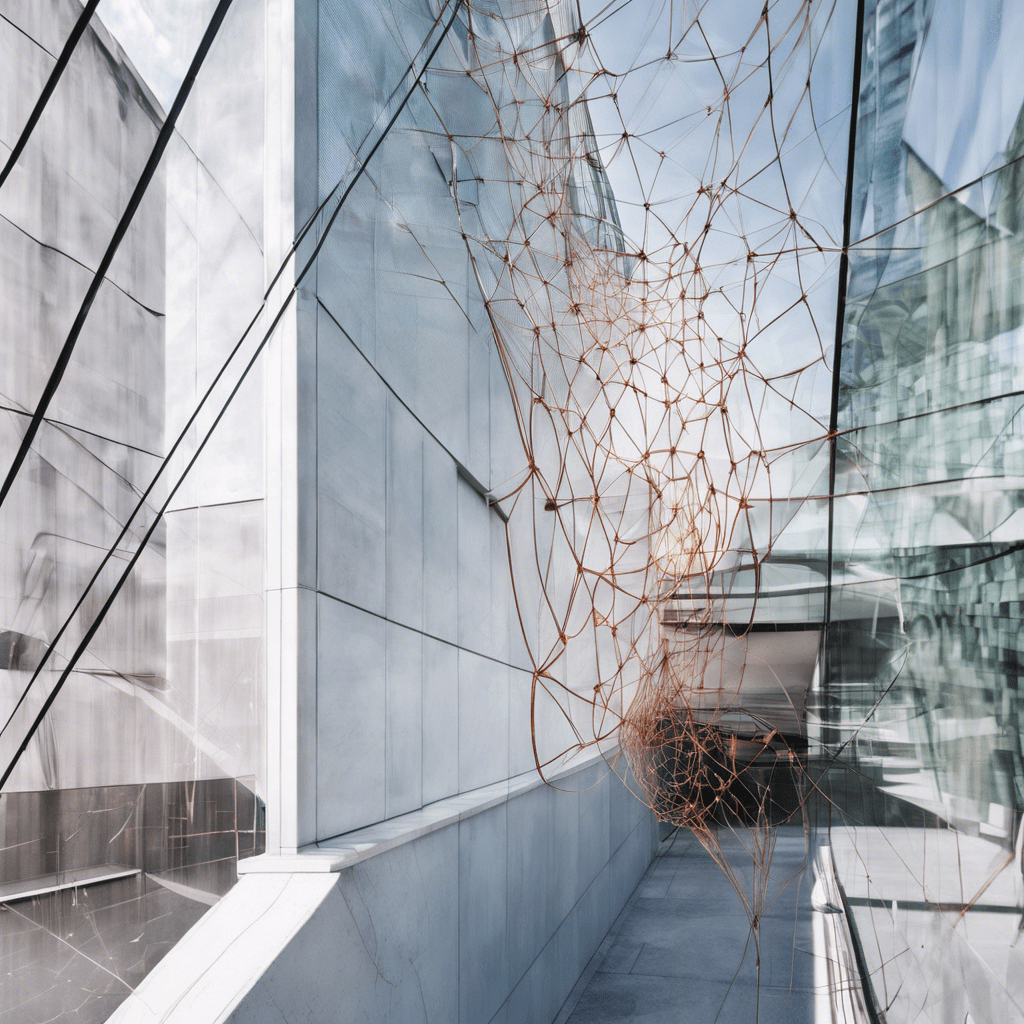
These visualizations show the architectural intervention as a streetside extension to JP Morgan’s 25 Bank Street site in Canary Wharf. The views show aluminum pipes (phase 1), elastic cables (phase 2), copper wire and data nests (phase 3), coordinate nodes, and seating shards at different times of the day.


The REWIRE Architectural Protest
REWIRE’s algorithm is designed to embody redundancy. Dubbed, ‘breaking points’, these strategically designed elements allow protesters to acquire sections of the architectural intervention without jeopardizing its stability. Each ‘acquired’ segment becomes a digital asset, tokenized on the REWIRE platform as an NFT, thus enabling protesters from the very sculpture commissioned by banks. Details for the architectural protest can be found in section 7 of the REWIRE thesis.
This section will focus on how redundancy is designed into the algorithm, thus enabling it to make a strong socio-economic statement by using data to design a spatial intervention.

The plan, front elevation, and right elevation on this unfolded drawing show a time-based interaction between pedestrians and protestors within the same architectural intervention.
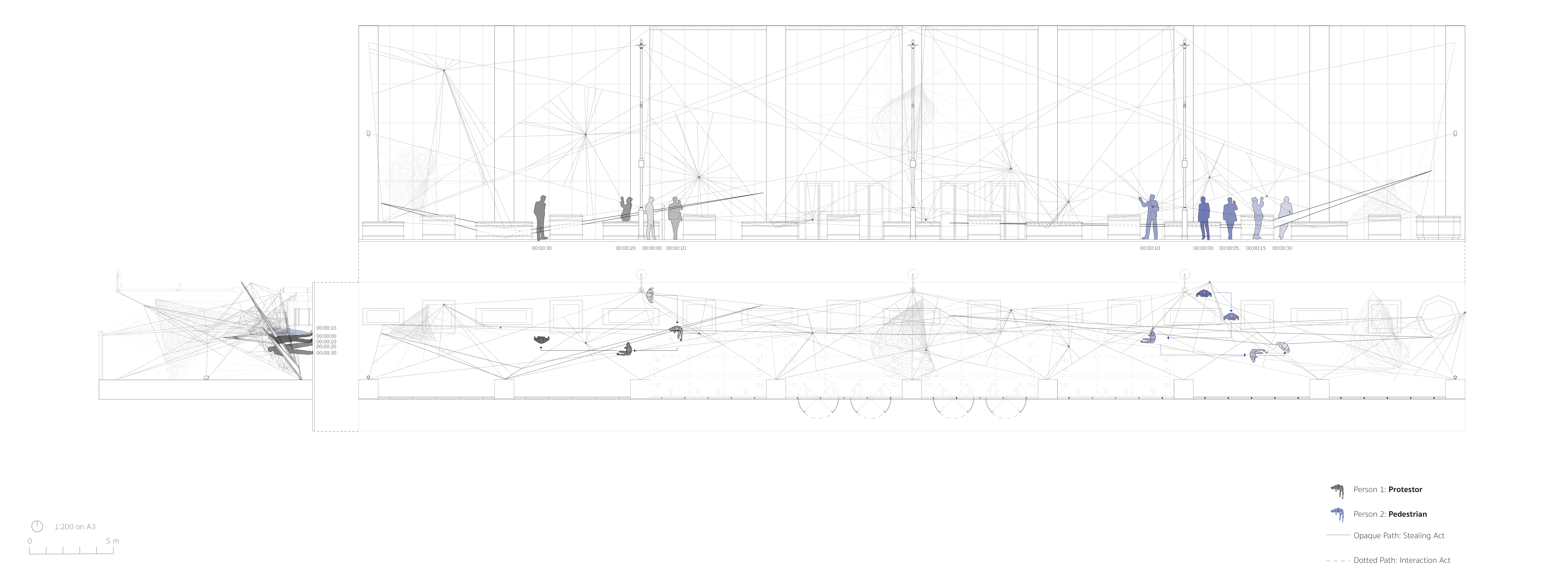
Protesters follow pre-organized circulation paths and acquire preidentified copper segments to physically redesign the intervention.

Further details for the architectural protest segment of REWIRE can be found on section 7 of the final thesis (pages 40 – 54). The protest ends in an architectural collapse with the dense web of copper, once an architectural marvel, becoming a formidable blockade, rendering the building entrance impassable. The revelation of unethical banking practices on such a grand scale shakes the financial industry to its core, igniting a public outcry against corporate malpractices. The REWIRE intervention, once an artistic and data-driven masterpiece, now serves as a catalyst for a massive paradigm shift, pushing society to confront the dark underbelly of financial institutions.
UAV Tests
This section describes studies on drone motion which will inform the development of the weaving algorithm. Physical tests were conducted using a manually controlled test drone. The weaving motion for loops and knots to create nodes across linear and surface structures was tested and documented. Different materials were used to simulate copper wire, including elastic string, sewing thread, and 9-gauge guitar wire.
Test 1: Weaving using wires
Linear structures, surface structures, and volumetric structures are connected at nodes. The node connection varies by material type and factors like friction, torsion capacity, tensile strength, and elasticity need to be considered when analyzing the result.


Test 2: Digital MATLAB UAV Movement Simulation
While physical tests informed specifications of UAV motion dynamics, digital tests were used to simulate point-following and obstacle avoidance. The logic behind the obstacle-avoidance programming can be embedded into the path-following algorithm for the drone to ensure that the intervention is continuously growing over its active period while being safe.
2.1 Testing Waypoint following on MATLAB
This test simulates waypoint following to see how a UAV path can be simulated by outlining specific points in its path. The code creates a controller that helps a UAV follow points to create its path. The code is simulated in Simulink.
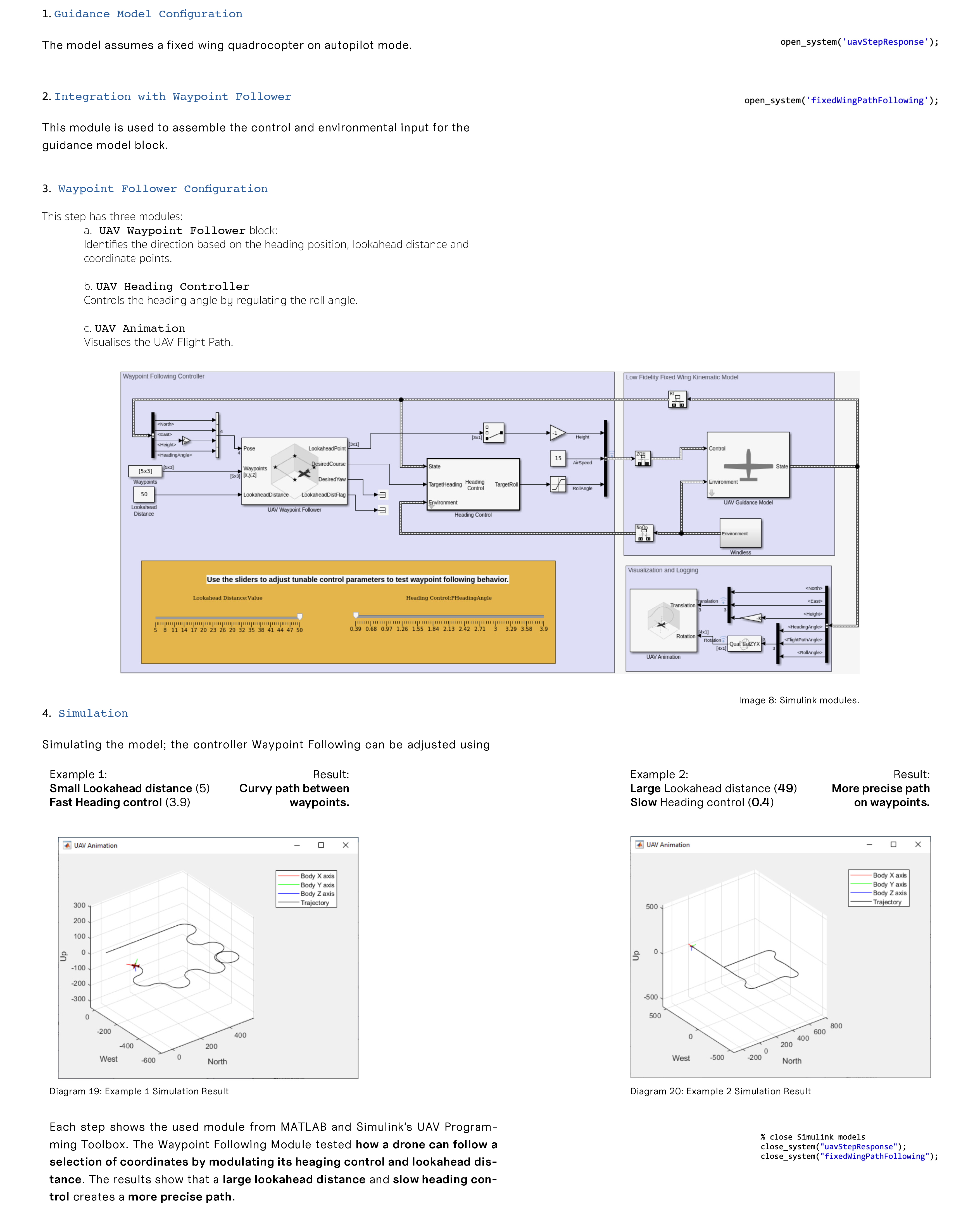
Testing Waypoint The Following helps the UAV weave Phase 1 elements on existing architectural latches. The next digital simulation tests Static Obstacle Avoidance, to ensure that the UAV can identify static objects, such as parked cars or lamp posts, to aid Phase 1 weaving by mapping the site accurately.
2.2 Testing Static Obstacle Avoidance on MATLAB and Simulink
Static Object Avoidance is when a drone uses LiDAR (Laser Imaging Detection and Ranging) to determine the distance from nearby objects and consequently change its path while still following the programmed trajectory. For the intervention, static object avoidance is important for two reasons:
- Noticing existing building elements to create a path around them.
- Detecting existing phase 1 and phase 2 and flying around them.

Programming the UAV for static obstacle avoidance helps factor in the presence of existing phase 1 and phase 2 elements for generative weaving.
2.3 Testing Static Moving Avoidance on MATLAB and Simulink
For the intervention, moving object avoidance is important for learning
Moving Object Avoidance is when a drone uses LiDAR (Laser Imaging Detection and Ranging) to determine the distance from nearby moving objects, guessing the direction of the moving object and consequently changing its path while still following the programmed path. For the intervention, moving object avoidance is important for learning about the presence of humans and flying around them to avoid injuries.

Testing obstacle avoidance for UAVs through MATLAB taught the logistics of how a UAV weaving a copper intervention can dynamically update its preprogrammed trajectory.
Designing UAV Attachments
To attach hooks for phase 1, create nodes for phase 2, and tie knots for phase 3, the UAV needs to work like fingers. This drawing outlines the three attachments designed to help the UAV conduct relevant movements. Each attachment helps replicate a finger movement clasping, pressing, and holding).
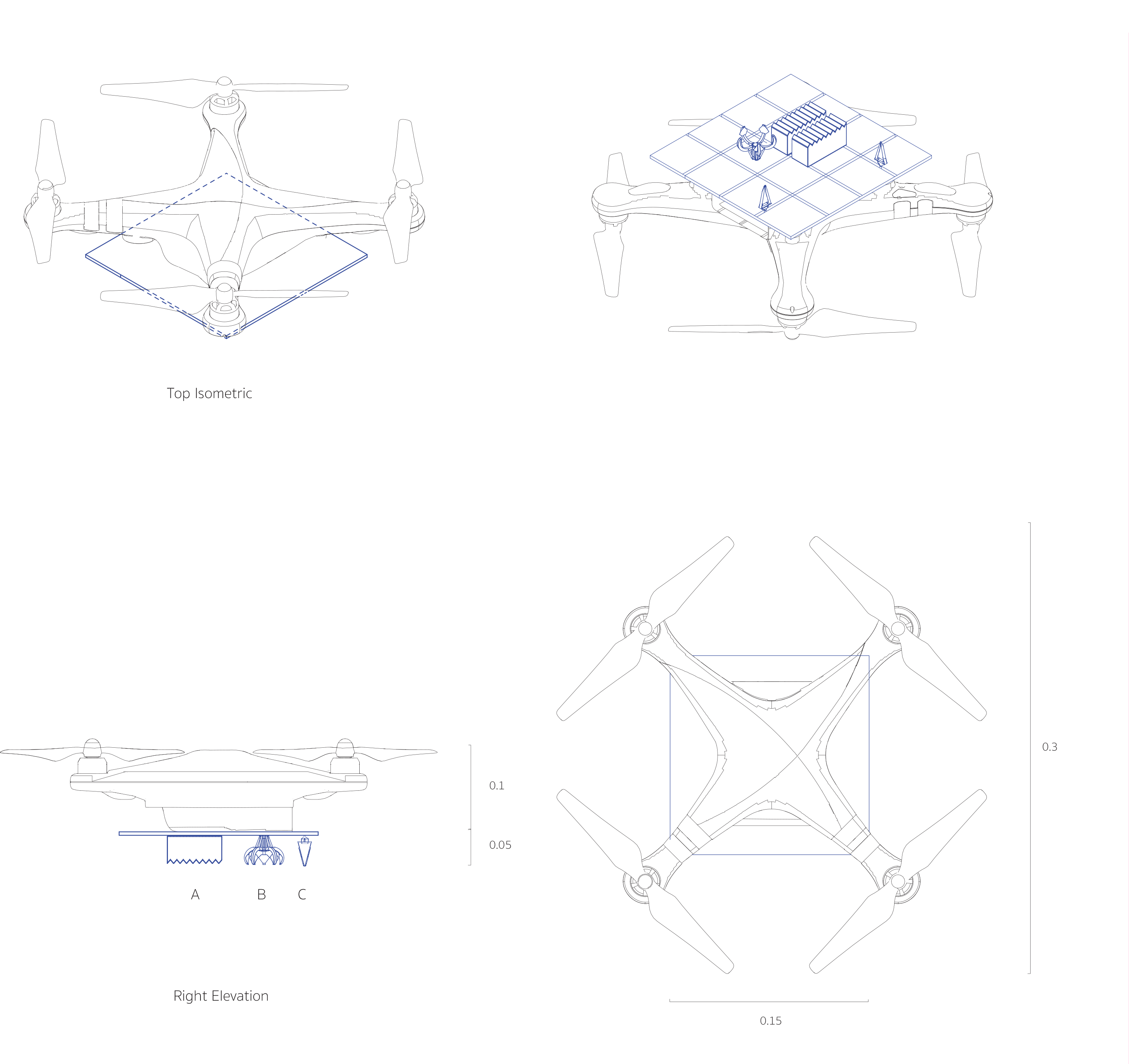
Three attachments aid UAV construction:
- Grabber: Releases and grabs the weighted Free End of the copper wire.
- Presser: Is fixed on the UAV base and is used to press parts of the knot.
- Holders: There are two holders, which hold and work the wires.

In conclusion, the REWIRE Algorithm is a complete feedback loop that uses banks’ data to weave a data-driven on-site architectural intervention that continuously redevelops and redesigns itself based on human interaction with the spatial sculpture. It enables participants to ‘acquire’ segments of the sculpture which can then be sold for their own profit. Therefore, the REWIRE system works as a spatial machine learning model that becomes a strong tool for socio-politic commentary against unethical capitalist exploiters in society.
Note: This project won the Peter Sabara Travel Award 2023, granted by the Architectural Association (AA) School of Architecture.
Additional Links:
Final REWIRE Technical Thesis: Link
 Aaryaa Kamdar